CURRENT STATUS AND MAIN TASKS FOR UPDATING REGULATORY PROVISIONS IN THE FIELD OF DESIGNING DRAINAGE ON IRRIGATED LANDS
- The role of land reclamation and water management in ensuring the sustainable development of agriculture
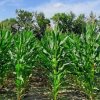
Purpose: to determine the productivity of corn hybrids of different maturity groups under drip irrigation.
Materials and methods. The research was carried out at the Biryuchekutsk vegetable breeding experimental station of the All-Russian Scientific Research Institute of Vegetable Growing, located in Rostov region, according to generally accepted methods for setting up and conducting field experiments. The soil of the site is ordinary carbonate, medium-thick, light loamy chernozem. Phenological observations carried out using standard field experimental methods included studying plant height, dynamics of herbage accumulation and leaf surface duration. The hybrids studied were: mid-early: MAS 34 B, Krasnodarsky 291 AMV; mid-season: KVS 3381, Zernogradsky 354 MV; mid-late: DKC 5007, P 0023.
Results. Features of corn hybrids of different maturity groups are manifested in plant height, leaf surface duration and accumulation of herbage. In the initial period of the growing season, the experimental variants practically did not differ in the specified parameters, and the difference was within the experimental error. Further development of plants occurred unevenly, and, depending on the hybrid, in the phase of 7–9 leaves, the accumulation of green mass in the experimental variants differed by more than 2 times. In the panicle phase, uniform development of plants was not observed, and the indicators of linear growth, leaf surface duration and herbage contrasted not only in the experimental variants, but also within the same experimental plot. The characteristics of the hybrids used began to appear clearly in the phases of milky and milky-waxy ripeness.
Conclusions: based on field studies, it was determined that the most productive corn hybrids under irrigation are: mid-early Krasnodarsky 291 AMV and mid-season Zernogradsky 354 MV.
corn, linear growth, productivity, plant density, herbage
Monastyrskiy V. A., Tishchenko Ya. S. Productivity indicators of corn hybrids of different maturity groups under drip irrigation. Ways of Increasing the Efficiency of Irrigated Agriculture. 2024;92(1):136–146. (In Russ.).
1. Serov K.N., 2021. Sovremennoe sostoyanie proizvodstva kukuruzy [Current state of corn production]. Molodoy uchenyy [Young Scientist], no. 22(364), pp. 78-79, EDN: LQNTPC. (In Russian).
2. Patsala S.V., Goroshko N.V., 2021. Selskoe khozyaystvo Rossii: globalnye pozitsii, strukturnye proportsii i tendentsii razvitiya [Agriculture in Russia: global positions, structural proportions and development trends]. Vestnik Kemerovskogo gosudarstvennogo universiteta. Seriya: Politicheskie, sotsiologicheskie i ekonomicheskie nauki [Bulletin of Kemerovo State University. Series: Political, Sociological and Economic Sciences], vol. 6, no. 1(19), pp. 96-108, DOI: 10.21603/2500-3372-2021-6-1-96-108, EDN: FJBLRZ. (In Russian).
3. Shiferaw B., Prasanna B.M., Hellin J., Bänziger M., 2011. Crops that feed the world. Past successes and future challenges to the role played by maize in global food security. Food Security, vol. 3, pp. 307-327, https:doi.org/10.1007/s12571-011-0140-5.
4. Melnik T.V., 2019. Aktual'nye voprosy vozdelyvaniya kukuruzy na zerno pri oroshenii [Current issues of cultivating corn for grain under irrigation]. Teoreticheskiy i prakticheskiy potentsial sovremennoy nauki: sb. nauch. st. [Theoretical and Practical Potential of Modern Science: Collection of Scientific Art]. Moscow, pp. 111-115, EDN: LIBXVE. (In Russian).
5. Torikov V.E., Belchenko S.A., Dronov A.V., Dyachenko V.V., Lantsev V.V., 2018. Kuku-ruza i sorgo v intensivnom zemledelii yugo-zapada Tsentral'nogo regiona Rossii [Corn and Sorghum in Intensive Agriculture of the South-West of the Central Region of Russia]. Bryansk, Bryansk State Agrarian University, 208 p., EDN: SXBKSO. (In Russian).
6. Nesterova E.M., Turchin V.V., Gromakov A.A., 2021. Vozdelyvanie kukuruzy na zerno s ispol'zovaniem regulyatorov rosta v usloviyakh Rostovskoy oblasti [Cultivation of corn for grain with growth regulators in Rostov region]. Prioritetnye napravleniya razvitiya sel'skokhozyaystvennoy nauki i praktiki v APK: materialy vserossiyskoy (nats.) nauchno-prakticheskoy konferentsii [Priority Directions for the Development of Agricultural Science and Practice in the Agro-Industrial Complex: Proc. of the All-Russian (National) Scientific-Practical Conference]. Persianovsky, pp. 118-120, EDN: RXQBMM. (In Russian).
7. Semykin V.A., Pigorev I.Ya., Oksenenko I.A., 2008. Vozdelyvanie kukuruzy na zerno bez gerbitsidov [Cultivation of corn for grain without herbicides]. Sovremennye naukoyemkie tekhnologii [Modern High Technologies], no. 4, pp. 44-46, EDN: IQFXMF. (In Russian).
8. Semina S.A., Inyakhin A.G., 2013. Vliyanie usloviy vyrashchivaniya na produktivnost' fotosinteza i urozhaynost' kukuruzy [Influence of growing conditions on the photosynthesis productivity and maize yields]. Niva Povolzh'ya [Crop Field of Volga Region], no. 1(26), pp. 35-39, EDN: QYOMWB. (In Russian).
9. Dospehov B.A., 2012. Metodika polevogo opyta (s osnovami statisticheskoy obrabotki rezultatov issledovaniy) [The Technique of Field Experience (with the Basics of Statistical Analyses of Research Results)]. Moscow, Book on Demand Publ., 352 p. (In Russian).
10. Sychev V.G. [et al.], 2003. Metodicheskie ukazaniya po provedeniyu kompleksnogo monitoringa plodorodiya pochv zemel' sel'skokhozyaystvennogo naznacheniya [Methodological Guidelines for Conducting Integrated Monitoring of Soil Fertility on Agricultural Lands]. Moscow, Rosinformagrotekh Publ., 240 p., EDN: TOYFNJ. (In Russian).
11. Klimenko A.I. [et al.], 2022. Zonal'nye sistemy zemledeliya Rostovskoy oblasti na 2022–2026 gody [Zonal Farming Systems of Rostov region for 2022–2026]. Rostov-on-Don, 736 p., EDN: GHQGWS. (In Russian).