CURRENT STATUS AND MAIN TASKS FOR UPDATING REGULATORY PROVISIONS IN THE FIELD OF DESIGNING DRAINAGE ON IRRIGATED LANDS
- The role of land reclamation and water management in ensuring the sustainable development of agriculture
Purpose: to develop a methodological approach to assessing the ecological state of a watercourse and the degree of anthropogenic load on it, proposals for optimizing the monitoring of anthropogenic impact on the watercourse.
Materials and methods. The method for calculating the coefficient of natural protection of a watercourse catchment area and the degree of anthropogenic load on it, criteria for the qualitative and quantitative characteristics of the anthropogenic load on a watercourse depending on the type of land use within the boundaries of the surface catchment is presented.
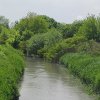
Results and discussion. The main provisions of the methodological approach to assessing the ecological state of a watercourse and the anthropogenic load on it are described. It is shown that the collector canal within the boundaries of a populated area is characterized by the highest degree of anthropogenic load (90 %) and an almost complete lack of natural protection from anthropogenic impact. The coefficient of natural protection of the surface catchment within the boundaries of irrigated lands is 0.143, the degree of anthropogenic load on the canal was 85.7 %, characterized as the highest, and theoretical calculations have established that in the case of protective forest plantations along the collector section, it (within this section) decreases by 3 %. The coefficient of natural protection of the surface catchment within the boundaries of dry lands is 0.4, the degree of anthropogenic load was 60 % and characterized as high.
Conclusions. Calculations of the degree of anthropogenic load on the watercourse depending on the type of land use within the boundaries of the surface catchment of the collector showed that it increases in the following sequence: dry lands → irrigated lands → populated area. The developed fundamental principles of the methodological approach to assessing the ecological state of a watercourse and the degree of anthropogenic load on it postulate that the permissible anthropogenic load on a section of a small water body in the zone of influence of a collector channel should not exceed the ecological capacity of the water body.
anthropogenic load on a water body, ecological capacity of a water body, collector, monitoring, indicator system for assessing the ecological state
Vlasov M. V., Drovovozova T. I., Olgarenko D. I. A methodological approach to assessing the ecological state of a watercourse and the degree of anthropogenic load on it. Ways of Increasing the Efficiency of Irrigated Agriculture. 2026;98(1):113–128. (In Russ.).
1. Popov A.N., 2024. O metodologii provedeniya reabilitatsii poverkhnostnykh vodnykh ob"yektov [On the methodology of the surface water bodies rehabilitation]. Vodnoe khozyaystvo Rossii: problemy, tekhnologii, upravlenie [Water Management of Russia: Problems, Technologies and Management], no. 4, pp. 87-107, DOI: 10.35567/19994508-2024-4-87-107, EDN: YDFLKW. (In Russian).
2. Shabanov V.V., Markin V.N., 2009. Metod otsenki kachestva vod i sostoyaniya vodnykh ekosistem [Method of Assessing Water Quality and the State of Aquatic Ecosystems]. Moscow, Moscow GUP, 154 p. (In Russian).
3. Oboldina G.A., Sambursky G.A., Popov A.N., 2019. Otsenka ekologicheskogo sostoyaniya vodnykh ob"yektov: unifitsirovannye podkhody dlya vypolneniya zadach natsional'nogo proekta «Ekologiya» [Assessment of the Water Bodies Ecological Status: Unificated Approaches to attaining of the “Ecology” national project objectives]. Vodnoe khozyaystvo Rossii [Water Sector of Russia: Problems, Technologies, Management], no. 4, pp. 32-56, EDN: SVLJWT. (In Russian).
4. Kiyok O.V., Redko A.N., Enina E.Yu., Krupoder A.S., Bogdan A.P., 2025. Sovremennye nauchnye i metodicheskie podkhody k monitoringu vodnykh ob"yektov i stochnykh vod: nauchnyy obzor [Modern scientific and methodological approaches to monitoring water bodies and wastewater: a scientific review]. Ekologiya cheloveka [Human Ecology], vol. 32, no. 9, pp. 616-627, DOI: 10.17816/humeco690078, EDN: YHTDQI. (In Russian).
5. Shiryaeva M.A., Naumenko N.O., Karpenko N.P., 2024. Primenenie innovatsionnykh tekhnologiy gidrologicheskogo monitoringa v tselyakh prognozirovaniya kachestva vody vodnogo ob"yekta [Innovative hydrological monitoring technologies for water bodies quality predicting]. Meditsina truda i ekologiya cheloveka [Occupational Health and Human Ecology], no. 2(38), pp. 175-190, DOI: 10.24412/2411-3794-2024-10212, EDN: PIBWBY. (In Russian).
6. Mkrtchyan F.A., Soldatov V.Yu., Mkrtchyan M A., 2024. Expert system for automating hydrophysical studies for the purpose of adaptive identification of water environment parameters in the optical range. Problems of Environment and Natural Resources, no. 6, pp. 129-144, DOI: 10.36535/0235-5019-2024-06-4, EDN: NTXDHF.
7. Bergua J.F., Hu L., Fuentes-Chust C., [et al]., 2021. Lateral flow device for water fecal pollution assessment: from troubleshooting of its microfluidics using bioluminescence to colorimetric monitoring of generic Escherichia coli. Lab Chip, no. 21(12), pp. 2417-2426, DOI: 10.1039/d1lc00090j, EDN: HJXUAH.
8. Willis J.R., Sivaganesan M., Haugland R.A., [et al]., 2022. Performance of NIST SRM® 2917 with 13 recreational water quality monitoring qPCR assays. Water Res, no. 212, article number: 118114, DOI: 10.1016/j.watres.2022.118114, EDN: BYHWPR.
9. Yaroshenko I., Kirsanov D., Marjanovic M., [et al]., 2020. Real-time water quality monitoring with chemical sensors. Sensors (Basel), vol. 12, no. 20, pp. 3432, DOI: 10.3390/s20123432, EDN: OWGRHO.
10. Dvornikova V.S., Kaverina N.V., 2016. Geokhimicheskoe sostoyanie donnykh otlozheniy poymennykh ozer Podgorenskogo gidrograficheskogo uchastka r. Don [Geochemical condition of benthal deposits in flood plain lakes of the Podgorensky Hydrographic Section of the Don River]. Vestnik Voronezhskogo gosudarstvennogo universiteta. Seriya: Geografiya. Geoehkologiya [Proceed. of Voronezh State University. Series: Geography. Geoecology], no. 1, pp. 71-74, EDN: VVSHTN. (In Russian).
11. Molev M.D., Paskarelov S.I., Miroshnichenko D.E., 2023. Otsenka soderzhaniya tyazhelykh metallov v donnykh otlozheniyakh reki Don [Evaluation of the heavy metal content in bottom sediments of the Don River]. Dnevnik nauki [Science Diary], no. 5(77), no. 40, DOI: 10.51691/2541-8327_2023_5_25, EDN BSBIUG. (In Russian).
12. Matishov G.G., Polshin V.V., Ilyin G.V., Usyagina G.S., 2023. Donnye otlozheniya del'ty Dona i soderzhanie tekhnogennykh radionuklidov v nikh [Bottom sediments of the Don Delta and the content of technogenic radionuclides in them]. Nauka Yuga Rossii [Science of the South of Russia], vol. 19, no. 3, pp. 29-38, DOI: 10.7868/S25000640230305, EDN: IVPHPJ. (In Russian).
13. Valiev V.S., Ivanov D.V., Shagidullin R.R., 2019. Metod kompleksnoy otsenki za-gryaznennosti donnykh otlozheniy [A method for integrated assessment of sediment pollution]. Trudy Karel'skogo nauchnogo tsentra RAN [Proceed. of Karelian Scientific Center of the Russian Academy of Sciences], no. 9, pp. 51-59, DOI: 10.17076/lim1122, EDN: FXERCC. (In Russian).
14. Bagmanov K.R., Shamaev D.E., 2025. Tsifrovye resheniya dlya monitoringa zagryazneniya donnykh otlozheniy vodoemov tyazhelymi metallami i nefteproduktami [Digital solutions for monitoring pollution of bottom sediments of water bodies by heavy metals and petroleum products]. Pishchevye tekhnologii i biotekhnologii: materialy KHIX Vseross. konf. molodykh uchenykh, aspirantov i studentov s mezhdunar. uchastiem [Food Technologies and Biotechnology: Proceed. of the 19th All-Russian Conference of Young Scientists, Postgraduate Students, and Students with International Participation]. Kazan, pp. 1113-1125, EDN: FHPVOR. (In Russian).
15. Karpenko N.P., 2018. Otsenka geoekologicheskoy situatsii rechnykh basseynov na osnove atributivnykh pokazateley i obobshchennykh geoekologicheskikh riskov [Assessment of the geoecological situation of river basins based on attribute indices and generalized geoecological risks]. Prirodoobustroistvo [Environmental Engineering], no. 2, pp. 15-22, EDN: XNSHWH. (In Russian).
16. Ivankova T.V., 2019. Otsenka stepeni antropogennoy nagruzki v basseyne maloy reki Al'my [Assessment of the degree of anthropogenic load in the basin of the small Alma River]. Vodosnabzhenie i sanitarnaya tekhnika [Water Supply and Sanitary Technique], no. 12, pp. 4-12, DOI: 10.35776/MNP.2019.12.01, EDN: ALEVVJ. (In Russian).